
Short Form Set
Short Form Set (30%, 30 points)
For twelve weeks this semester, we will as a group gradually create a collection of different kinds of annotations and entries related to course readings--what I am calling a Short Form Set. The short forms vary. They are due no later than noon on the day of class. This is so I can access them just ahead of our meeting. They should be posted 1) in your own Google Folder and also 2) in the respecive course folders and document locations posted with each type of entry listed below. This detail--posting in two places--is important because it ensures that your work will be available to everyone else and it will also be safe-kept in your folder as a backup copy where I can provide you with private comments.
Everyone has been scheduled for the following short forms and dates. There are twelve dates, but you begin the semester with a free pass to opt out of two of the dates. With this, there is an element of flexibility; you can adjust your schedule to account for weeks when you may be traveling or have a major project due in another class. I will ask about the dates you wish to clear in the second class meeting, on January 30. Note, too, that almost everyone is expected to complete a short form for the second class session so that we can discuss together some of the nuances involved. Follow this link to view the complete schedule table.
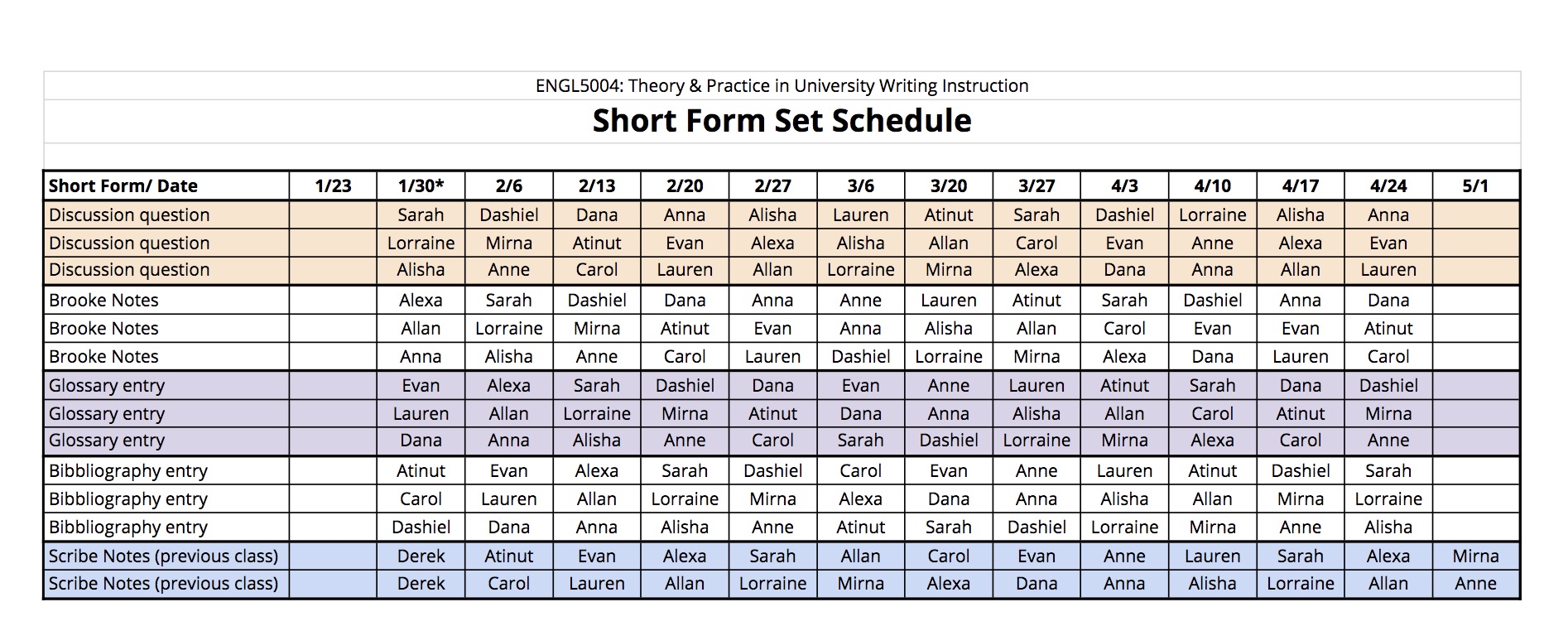
Completing ten short form entries contsitutes your set, weighted at 30 points, or 30% of the course grade. Each of the five short form types is detailed below.
Discussion Questions (~40 minutes)
Post in this shared Google Doc and in your own Google Folder.
Weekly discussion questions set up our responses to the reading. They can seek context or clarification. They can ask about meaning or about application. Effective questions should include a point-at-able location in the text, including a page number. If you wish to pose a general question (or series of questions), you should set the question up by drawing upon the text and providing some insight into your own curiosity or rationale for asking. A discussion question should generate open, exploratory conversation. With this in mind, it might lead us into or through a controversy, a paradox, or a wicked problem you discover while you are reading. In a week when you are assigned to discussion question(s), you may pose one or two questions that connect with the assigned reading. Questions should be approximately 80-120 words. At the end of the entry, include [in square brackets] your name and the associated date from the Short Form Set schedule, e.g., [Derek Mueller, 1/23]. As the questions grow, please list them in reverse chronological order, so the newest questions are near the top of the document.
Brooke Notes (~45 minutes)
Post in this shared Google Folder and in your own Google Folder.
Brooke Notes are a note-keeping system designed to be routine, generative, usable, and accumulative throughout and beyond your graduate program of study. This approach to note-keeping, which I credit to Collin Brooke, takes as its first principle that if it warrants reading, it warrants annotation. Even more, scholarly and curricular reading warrants annotation that is right-sized (i.e., neither excessively thorough nor too thin to be useful later on) and built-up in a database that you can search later on. Whether or not that database is kept publicly is up to you; there are strong arguments on both sides of the decision to post such notes publicly or, instead, to keep them privately, and we will discuss some of these considerations in class.
Here are a few general provisions for Brooke Notes:
- Develop your notes entry while the reading is reasonably fresh, preferably within a few hours of reading and never more than a day later.
- Set a timer. Try to keep the development of your notes entry to under an hour.
- An entry's scope should be between 400-1000 words. Longer entries make sense for complex or inspirational articles and book-length works. Briefer entries are appropriate for most scholarly articles.
- Such note-keeping practices are habitual and accumulative; they will over time amount to a personal archive invaluable to the development of lit reviews and a reliable, lasting resource of personal knowledge.
Learn more about the rationale for this approach and the basic guidelines for developing a Brooke Notes entry over here: http://www.cgbrooke.net/2014/01/16/reading-notes/. Each entry should—at a minimum—include the following:
- A title. Lastname, Firstname. Title of article, abbreviated, if necessary.
- A full citation adhering to MLA or APA style. This should be complete and correct, ready to copy into a bibliography, references list, or works cited.
- A one- or two-sentence summary, or an abstract. This should capture concisely what is the focus of the reading. If an abstract is already available, it is fine to copy/paste it into your notes. But writing your own abstract is excellent practice, too, as such summaries are challenging and require a thorough sense of the reading.
- Keywords/tags. A list of 5-10 keywords or phrases that index the entry in terms of important terminology, methods and methodologies, sites/materials/objects of analysis, and theoretical underpinnings.
- 2-3 citations. These are sources cited in the reading that you consider especially important, insightful, and possibly worthy of your tracking them down as reading cascades into further reading. Include the full citation information.
- 2-3 quotations. These are gem passages, either for the ways they capture striking ideas, pose questions, or connect with things you are thinking about, working on, or considering important. Include a parenthetical page or paragraph number to make the quotation easy to locate later on.
- 1-2 questions. These are questions you formulate that articulate the edges of wonder and prime further exploration.
A complete Brooke Notes entry will include all seven of these elements. Coordinate with others assigned to Brooke Notes for any given week how you will divide the readings to ensure coverage of all assigned readings, as much as possible. In addition to saving the Brooke Notes entry as a document in your Google Folder, submit a copy of it to our shared folder for Brooke Notes, located here.
Glossary Entries (~40 minutes)
Post in this shared Google Doc and in your own Google Folder.
Glossary entries select a key word of phrase from the reading in any week and record it here with an elaborated definition. Generally, definitions should be earnest attempts to provide insight into the meaning of the word or phrase, but you are also entrusted with some playfulness in the form of parody and juxtaposition. That is, you can add entries that get at meaning contrastively or with surprising, even polemic characterizations. A terrific example of this is in Jonathan Safran Foer’s Eating Animals:
Bullshit (n.): 1) The shit of a bull (see also: ENVIRONMENTALISM); 2) Misleading or false language and statements, such as:
Bycatch (n.): Perhaps the quintessential example of bullshit, bycatch refers to sea creatures caught by accident--except not really “by accident,” since bycatch has been consciously built into contemporary fishing methods. (49)
Notice here the cross-referencing (viz., see also:) and the setup shared across the entries (viz., such as:). This may be challenging to orchestrate, but it remains on offer for you to use this space for etymological play--a little bit Foer, a little bit Urban Dictionary, but mostly a chronicle of words and phrases we encounter and would do well to log for future returns. In a week when you are assigned to the glossary, you should add up to but not more than three glossary entries totallying no more than 120 words. At the end of an entry, include [in square brackets] your name and the associated date from the Short Form Set schedule, e.g., [Derek Mueller, 1/23]. As the questions grow, please list them alphabetically, so we can easily look terms up.
Bibliography (~40 minutes)
Post in this shared Google Doc and in your own Google Folder.
How does it work? Bibliography entries consist of a full citation, correctly formatted according to MLA 8, for one source relevant to the readings for the week. This can be a source referenced in something we read. It can be a source tangentially associated by topic or by author. In addition to the full citation, the bibliographic entry must include a 100-150 word synopsis of the source, accounting for some of the following: basic premise, key assertions, authorship, timing, or alignment with a particular approach to teaching writing. To learn this will in many cases require at least a partial reading of the source in question, which means you may have to locate the source through Newman Library. At the end of the entry, include [in square brackets] your name and the associated date from the Short Form Set schedule, e.g., [Derek Mueller, 1/23]. As the bibliography grows, double-check to make sure new entries are listed in alphabetical order, and exercise care to make sure you don’t accidentally overwrite entries by your colleagues.
Scribe Notes (~75 minutes plus note-keeping in class)
Post in this shared Google Folder and in your own Google Folder.
In keeping with the National Writing Project tradition of scribe notes, ENGL5004 scribe notes are one-page encapsulations of the previous class meeting. They are a blended genre in that they function somewhat like minutes, but they also call upon you to consider layout, typeface, and visual elements (at lease one must be included). They can be hand-written, even doodled, serious or playful, simple or elaborate, but they must account for the previous class meeting on one 8.5x11 page. When two people are assigned to Scribe Notes, you may decide to work independently or collaboratively. Save your scribe notes as a PDF, upload them to the class's shared folder for Scribe notes, located here, and also place a copy in your own Google Folder for ENGL5004. Finally, when you come to class, bring fifteen paper copies to class.
Contact Information
Derek N. Mueller, PhDProfessor
Department of English
Virginia Tech
Office: 315 Shanks Hall
Phone: +1-734-985-0485 (Google voice)
dmueller@vt.edu
http://derekmueller.net/rc/
